
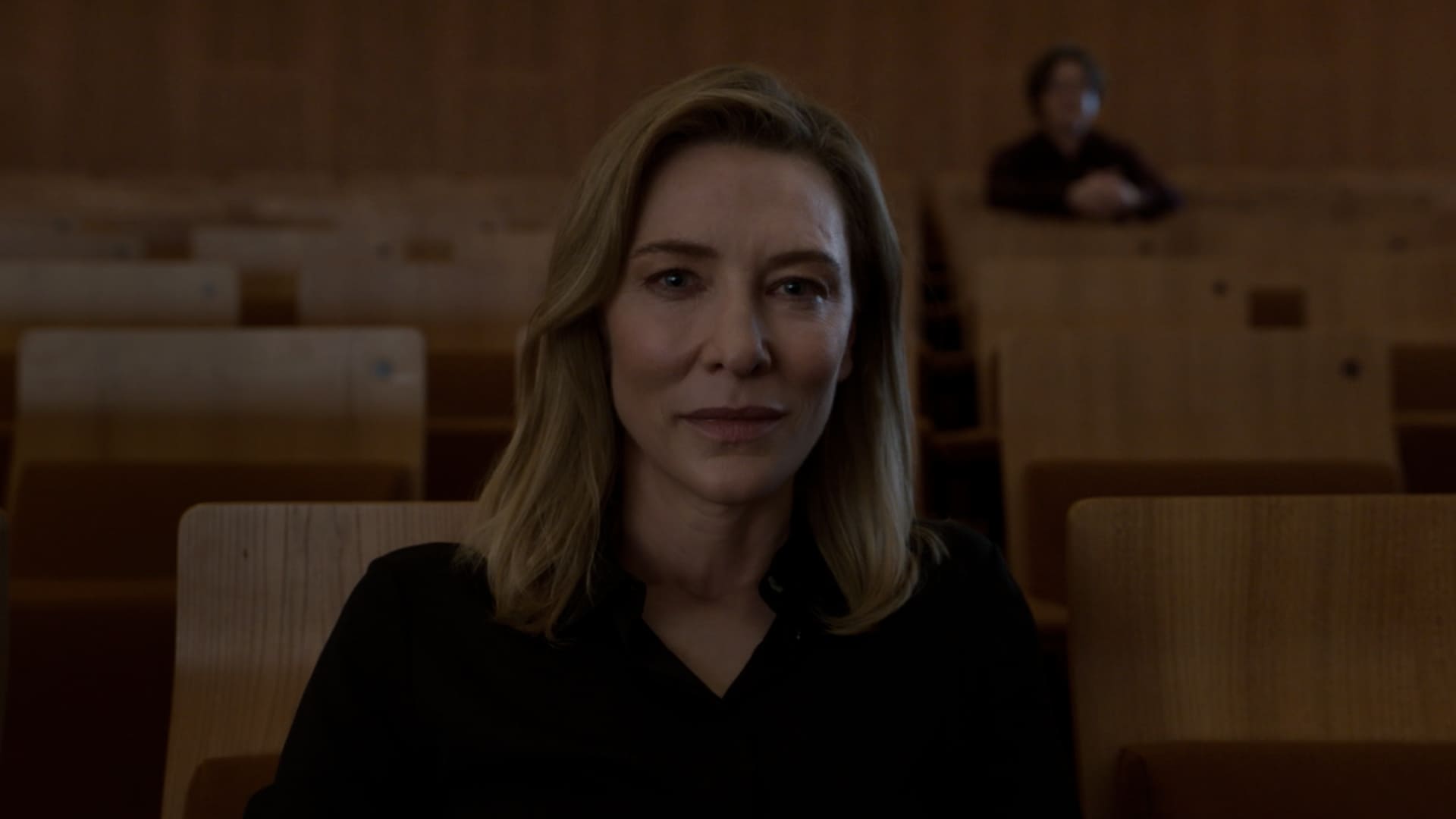
Standing in front of a professional orchestra and convincing audiences that you belong there requires far more than waving a baton. That was the challenge Cate Blanchett faced when she took the title role in Tár, Todd Field’s 2022 psychological drama. Blanchett plays Lydia Tár, a fictional conductor operating at the highest levels of classical music, where talent, authority, ambition, and ego become deeply intertwined. Although the story reaches far beyond music itself, making Lydia believable as an accomplished conductor was essential. Blanchett therefore had to develop enough technical confidence to appear completely at home on the podium.
For Blanchett, conducting became one of the most fascinating parts of preparing for the role. She watched hundreds of hours of conductors and discovered that their physical styles could be remarkably individual. Conducting was not simply about keeping time. Different musicians communicated through distinctive movements, gestures, posture, and energy. That realization gave Blanchett greater freedom to create Lydia’s physical identity while maintaining the technical credibility required for the character. Because many scenes depict rehearsals rather than polished concerts, every movement needed to suggest someone capable of identifying problems and shaping an orchestra in real time.
Authenticity was particularly important to director Todd Field. The production wanted viewers familiar with classical music to believe what they were seeing, so performers were expected to carry out many of the musical actions themselves. When Blanchett conducts on screen, she is genuinely leading the musicians rather than having the essential movements created through editing or substituted by another performer. The orchestra responds to her cues, making the relationship between conductor and musicians feel immediate. That practical approach helps reinforce Lydia’s authority before the film begins questioning other aspects of her character and behavior.
Blanchett’s work also impressed Sophie Kauer, the young cellist who plays Olga Metkina. Kauer came to the production with genuine classical training, making her especially qualified to recognize whether the musical performances felt convincing. She explained that when audiences see her playing the cello, they are actually hearing and watching her perform. Likewise, Blanchett’s conducting had a real effect on the orchestra, whose musicians followed her downbeat. Kauer noted that conducting is considerably harder than it appears and praised Blanchett’s musical instincts and commitment.
That attention to detail is important because Tár uses the classical music world as the foundation for a much broader examination of power, identity, control, and consequence. Lydia must first appear unquestionably accomplished for the later developments in her story to carry their full weight. Blanchett’s preparation helps establish that credibility. By learning how conductors communicate with an orchestra rather than simply imitating their gestures, she created a performance grounded in genuine musical technique. The result makes Lydia Tár feel less like an actor pretending to conduct and more like someone who has spent a lifetime expecting an orchestra to follow her every movement.
