
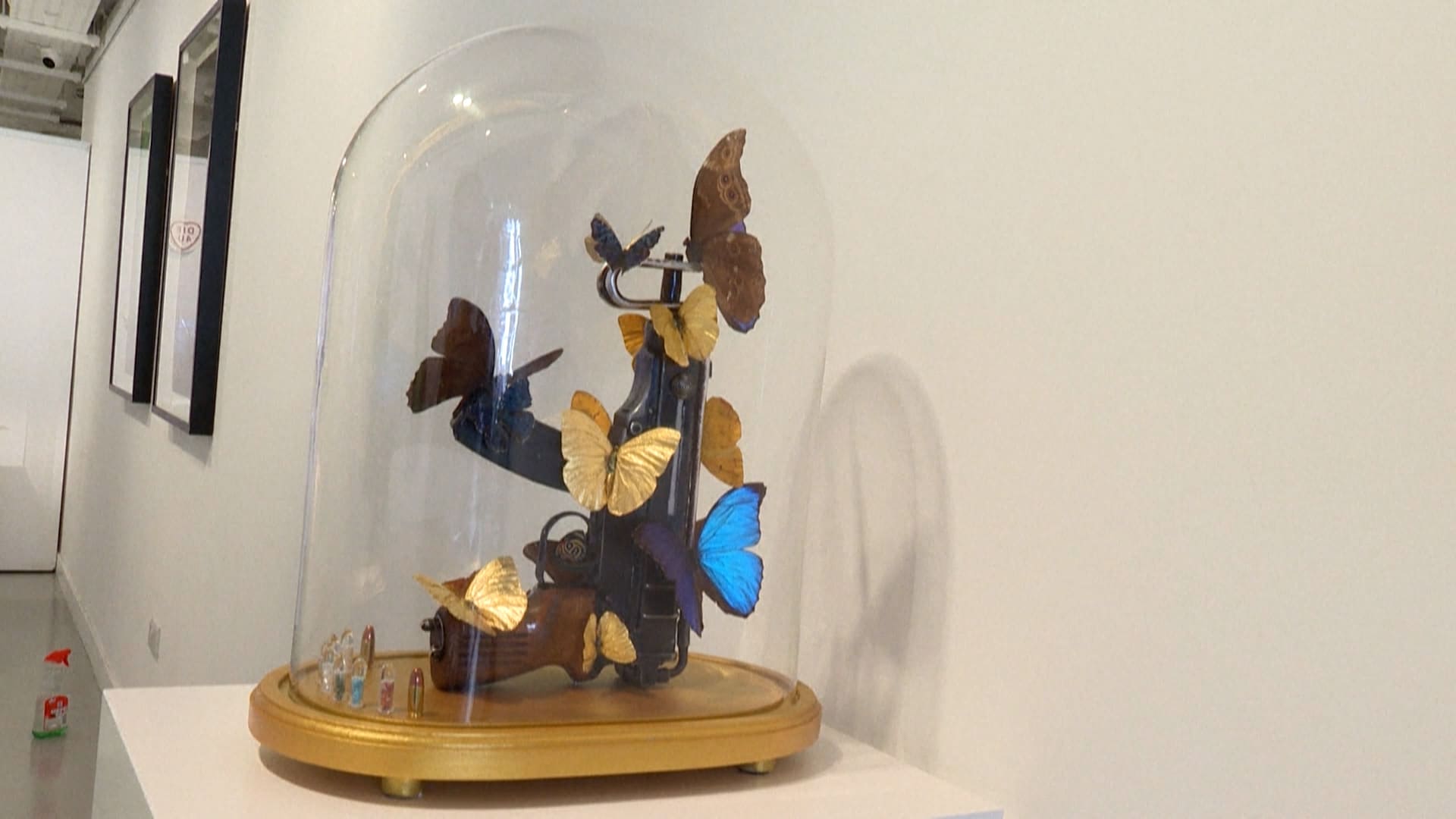
Art can become far more powerful when there is a story behind it. For Bran Symondson, that story began far away from the traditional world of galleries and studios. Before becoming an artist, Symondson worked as a photographer in the fashion and advertising industries, building a creative career before deciding to challenge himself in an entirely different environment. He joined the British military reserves and spent two years completing the selection process for the UK’s Special Forces reserves. Eventually, his service took him to Afghanistan, where an unexpected encounter would influence the direction of his artistic career.
While serving in Afghanistan, Symondson noticed something unusual among local communities: people were decorating AK-47s and transforming weapons into highly personalized objects. The contrast between something associated with conflict and something created for visual expression immediately caught his attention. After returning to his creative work, he began exploring the idea himself, eventually developing a body of work that transformed weapons into provocative pieces of contemporary art. The result became The Art to Disarm, an exhibition built around several interconnected ideas about conflict, consumerism, nature, and human behavior.
At the center of Symondson’s work is a broader question about the relationship between capitalism and nature. His exhibition examines how economic systems, human consumption, and the weapons industry can contribute to environmental and social consequences. Rather than presenting these subjects as distant political concepts, Symondson uses unexpected artistic objects to make them more immediate. His work encourages viewers to stop and consider how ordinary patterns of buying, working, producing, and consuming can connect to much larger global systems.
One of the clearest examples is The Colony, an artwork built around a functioning ant nest. Symondson drew a comparison between the organized behavior of ants and modern human society. Ants constantly move around their environment, collect resources, and return them to the colony, while people similarly spend their days traveling to work, earning money, purchasing goods, and contributing to an economic system. The comparison is intentionally simple, but that simplicity makes the idea accessible. By watching the ants follow their routines, viewers are encouraged to recognize familiar patterns in their own lives.
Symondson’s journey from a photographer and soldier to an artist might appear unusual, but he sees a natural connection between the two worlds. He has observed that some former soldiers eventually turn toward creative pursuits, perhaps because experiencing intense environments can create a desire for calm, reflection, and expression. His studio therefore represents almost the opposite of the battlefield. Through art, Symondson takes objects associated with conflict and places them into a setting where viewers can question their meaning. His work ultimately demonstrates how experiences from very different parts of life can come together to create art that is visually striking while asking difficult questions about humanity, consumption, conflict, and the world around us.
